Formula DSL reference
Every model in gamfit uses a Wilkinson-style formula:
Terms are joined with +. * and : are not supported; interactions
come from multivariate smooths (s(x1, x2), te(x1, x2),
matern(...), duchon(...)).
This page lists each right-hand-side term, its options, and the
formula-level configuration terms (link(...), linkwiggle(...),
timewiggle(...), survmodel(...)).
Response (left of ~)
| Response | Default behaviour |
|---|---|
y continuous |
Gaussian family, identity link. |
y binary {0, 1} |
Binomial family, logit link. |
y count, with link(type=log) and explicit family |
Poisson. |
y positive continuous, with link(type=log) |
Gamma. |
Surv(entry, exit, event) |
Survival model. See survival.md. |
The family is inferred from the response with family="auto". Override
with family= or by setting an explicit link().
Linear and constrained coefficients
y ~ x                                # implicit penalized linear
y ~ linear(x)                        # explicit linear
y ~ linear(x, min=0)                 # box-constrained coefficient >= 0
y ~ linear(x, min=-1, max=1)         # box-constrained coefficient
y ~ nonnegative(x)                   # sugar for linear(x, min=0)
y ~ nonpositive(x)                   # sugar for linear(x, max=0)
y ~ bounded(x, min=0, max=1)         # exact interval transform on x
linear(x, min=..., max=...) keeps a penalized linear term and
projects the coefficient into [min, max]. Accepted aliases for the
same function: linear, constrain, constraint, box. Each accepts
min/lower and max/upper. constrain()/constraint()/box()
requires at least one of those four to be set.
bounded(x, min, max) applies an exact interval transform to x. It
is a distinct term type from linear, not a constrained linear.
Required options: min and max (finite, min < max).
bounded() priors
bounded() accepts one of prior=, target=+strength=, or no
prior:
bounded(x, min=0, max=1, prior=uniform)
bounded(x, min=0, max=1, prior=center)
bounded(x, min=0, max=1, target=0.5, strength=3)
prior= values:
none— flat on the transformed scale, no penalty.uniform(aliaseslog-jacobian,log_jacobian,jacobian) — flat on the original scale, applied as a log-Jacobian correction.center—Beta(2, 2)toward the midpoint.
target plus strength is shorthand for a Beta prior:
a = 1 + strength * z, b = 1 + strength * (1 - z) with
z = (target - min) / (max - min). target must lie strictly between
min and max; strength must be positive.
prior=, target/strength, and the (legacy) pull= shorthand are
mutually exclusive.
Random effects and factor smooths
y ~ x + group(site)
y ~ x + re(site)                         # alias of group()
y ~ s(x, by=site) + site                 # separate smooth per factor level
y ~ s(x, by=z)                           # numeric varying-coefficient smooth
y ~ s(x, site, bs="fs")                  # partial-pooling random smooths
y ~ fs(x, site)                          # alias for bs="fs"
y ~ s(site, x, bs="sz") + s(x)           # sum-to-zero deviations
y ~ sz(site, x)                          # alias for bs="sz"
y ~ s(site, x, bs="re") + group(site)    # random slopes + random intercepts
group(name) and re(name) add a random intercept per level of a
categorical column. The single argument must be a column name.
A by= option on a smooth multiplies the smooth basis by a column.
For a categorical by=, one smooth is built per kept level; include
the factor main effect (e.g. + site or + group(site)) when level
offsets should be identifiable. For a numeric by=, the result is a
varying-coefficient smooth.
bs="fs" builds factor smooths: each group gets its own curve,
including penalized null-space components (intercept and linear
trend). The default m=2 applies two null-space shrinkage penalties;
set m=1 to apply one. New groups at prediction time contribute zero
for the term.
bs="sz" builds sum-to-zero factor-smooth deviations; deviations sum
to zero across factor levels at each spline coefficient. Use with a
population smooth such as s(x).
bs="re" with one grouping column and one numeric column builds
random slopes as a factor-by-linear basis with an identity ridge
penalty.
The fs/sz/re factor-smooth path accepts k, basis_dim,
knots, degree, penalty_order, m (fs only), and
double_penalty. It requires exactly two variables: one categorical
or binary grouping column and one continuous (or binary) numeric
column.
Univariate smooths
y ~ s(x)                    # P-spline (B-spline + difference penalty)
y ~ smooth(x)               # alias of s()
y ~ s(x, k=15)              # basis dimension 15
y ~ s(x, knots=10)          # 10 interior knots
y ~ s(x, degree=3, penalty_order=2)
y ~ s(x, type=ps)           # explicit P-spline
y ~ s(x, double_penalty=true)
For a single covariate, s(x) defaults to a cubic P-spline with a
second-order difference penalty.
| Option | Default | Meaning |
|---|---|---|
k (basis_dim) |
from data | Total basis dimension. |
knots |
from data | Number of interior knots. Cannot combine with k. |
degree |
3 | Polynomial degree of the B-spline. |
penalty_order |
2 | Order of the difference penalty. |
type |
ps (1-D), tps (≥2-D) |
One of ps, tps, matern, duchon, etc. |
double_penalty |
true |
Add a ridge penalty alongside the difference penalty. |
bc |
free |
Same boundary condition on both ends: free, clamped, or anchored. |
bc_left, bc_right |
free |
Per-endpoint boundary condition. Aliases: left_bc/right_bc, start_bc/end_bc. |
anchor, anchor_left, anchor_right |
0 | Anchor value for anchored. Aliases: anchor_value, value, left_anchor, right_anchor. |
by |
none | Column for varying-coefficient or by-factor smooths. |
The 1-D B-spline path accepts these options plus periodic, period,
periods, period_start, period_end, origin, identifiability.
Default interior knots:
clamp(unique_values / 4, 4, max(20, cbrt(unique_values))). The basis
dimension is then k = internal_knots + degree + 1. Passing both k
and knots is an error.
Boundary-condition values: free/none/open,
clamped/zero_derivative, anchored/zero/zero_value. clamped
forces zero first derivative at the endpoint; anchored pins the
endpoint value (anchor defaults to 0, currently the only supported
anchor value).
y ~ s(x, bc=clamped)                       # zero slope at both endpoints
y ~ s(x, bc_left=clamped)                  # zero slope at the start, free at end
y ~ s(x, bc_left=anchored, anchor_left=0)  # endpoint value pinned to 0
y ~ s(x, start_bc=clamped, end_bc=anchored, end_anchor=0)
bc(x) (aliases boundary(x), boundary_conditioned(x)) is sugar for
s(x, bc=clamped); if any anchor option is set, it defaults to
bc=anchored. Per-side overrides are read directly by the smooth
builder.
Multivariate smooths
y ~ s(x1, x2)                # thin-plate (default for >=2 args)
y ~ tps(x1, x2)              # alias of thin-plate
y ~ thinplate(x1, x2)        # alias
y ~ thin_plate(x1, x2)       # alias
y ~ matern(x1, x2, x3)
y ~ duchon(x1, x2, x3)
y ~ te(x, z)                 # tensor product
y ~ tensor(x, z)             # alias
y ~ interaction(x, z)        # alias of te()
Thin-plate (tps, thinplate, multivariate s(...))
Radial-basis surface smooth with thin-plate kernel.
| Option | Default | Meaning |
|---|---|---|
centers (k, basis_dim) |
auto | Number of radial centres. |
length_scale |
auto (data-derived) | Global length-scale init. |
double_penalty |
true |
Ridge + main penalty. |
scale_dims |
false |
Per-axis input standardisation. |
include_intercept |
false |
Append a constant column. |
by, identifiability |
— | See common options above. |
Matérn (matern)
Radial basis with Matérn covariance kernel.
| Option | Default | Meaning |
|---|---|---|
centers (k, basis_dim) |
auto | Number of centres. |
length_scale |
auto | Global length-scale init. |
nu |
5/2 |
Smoothness, one of 1/2, 3/2, 5/2, 7/2, 9/2. |
include_intercept |
false |
Append a constant column. |
double_penalty |
true |
Ridge + main penalty. |
scale_dims |
false |
Per-axis anisotropy (learns per-axis log-scales). |
Higher nu gives smoother sample paths. nu=1/2 is rejected for
d >= 2 because the exponential kernel's Laplacian is singular at
zero, which makes the operator-collocation penalty non-invertible.
Duchon (duchon)
Radial basis with triple-operator regularization (mass + tension +
stiffness). Scale-free unless length_scale is given.
| Option | Default | Meaning |
|---|---|---|
order (nullspace_order) |
auto | Polynomial nullspace order. |
power (p) |
auto | Kernel power. |
centers (k, basis_dim) |
auto | Number of centres. |
length_scale |
none (scale-free) | Optional global scale. |
scale_dims |
false |
Per-axis contrasts. |
periodic, period, period_start, period_end |
— | 1-D cyclic Duchon (see below). |
duchon() rejects double_penalty; the three operator penalties
(mass, tension, stiffness) each get their own smoothing parameter
under REML.
Tensor product (te, tensor, interaction)
Kronecker product of univariate B-spline bases. Each axis has its own smoothing parameter. Use when axes have different units (space × time).
| Option | Default | Meaning |
|---|---|---|
k (basis_dim) |
auto, per margin | Basis dim per margin. List form k=[k1, k2] accepted. |
knots |
auto, per margin | Interior knots per margin. List form accepted. |
degree |
3 | Polynomial degree (all margins). |
penalty_order |
2 | Difference-penalty order. |
double_penalty |
false |
Ridge alongside per-margin penalties. |
bc |
none | Per-margin boundary conditions (list form). |
periodic, period, periods, origin, origins |
— | Per-margin periodicity (see below). |
by, identifiability |
— | See common options above. |
k and knots cannot both be set. Margins requested as a single
value are broadcast across all margins.
Picking the right smooth
| Situation | Term |
|---|---|
| One covariate | s(x) |
| Two coordinates, same units | s(x, y) or matern(x, y) |
| Coordinates in different units | te(x, t) |
| Three or more coordinates | duchon(...) with scale_dims=true, or matern(...) |
| Direct control of wiggliness | matern(..., nu=...) |
| Scale-free behaviour | duchon(...) without length_scale |
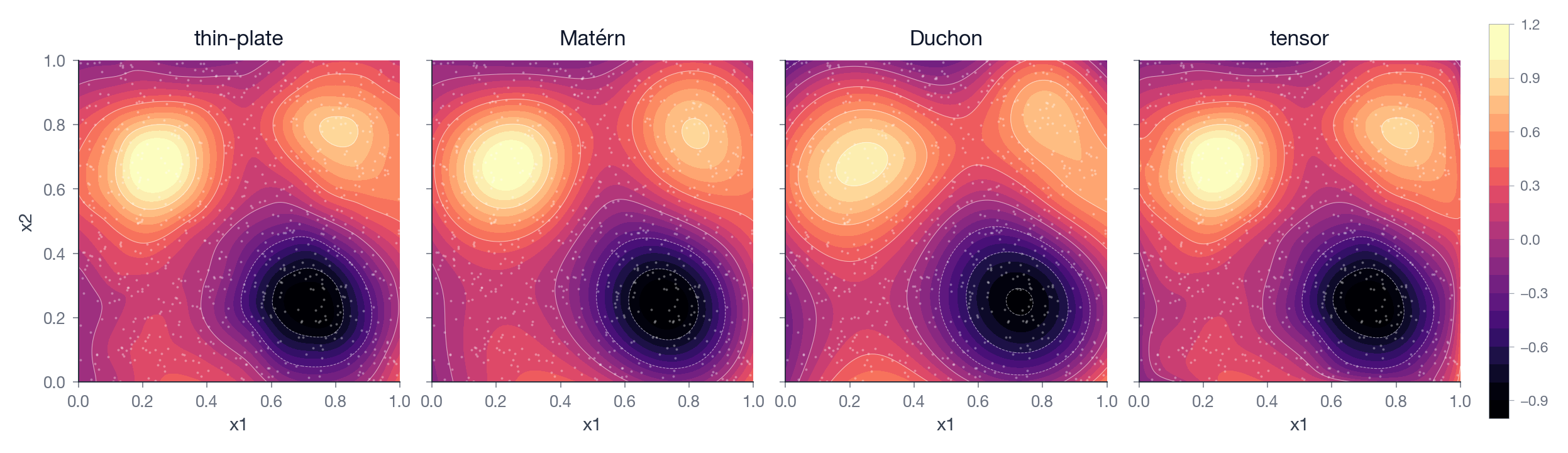
Periodic and cyclic smooths
y ~ s(theta, periodic=true, period=6.283)             # cyclic 1-D B-spline
y ~ cyclic(theta, period_start=0, period_end=6.283)   # alias of s(..., periodic=true)
y ~ periodic(theta, period=6.283)                     # alias
y ~ cp(theta, period=6.283)                           # alias
y ~ cc(day_of_week, period=7)                         # mgcv-style alias

# Tensor with one or more periodic margins
y ~ te(theta, h,  periodic=[0], period=[2*pi, None])
y ~ te(theta, phi, periodic=[0, 1], period=[2*pi, 2*pi])
y ~ te(day, hour, bc=['periodic','periodic'], periods=[7, 24], origins=[0, 0])
cyclic, periodic, cc, cp are aliases of s(..., type=cyclic).
periodic=[axes] lists zero-based axis indices that wrap. period= or
periods= holds one positive period per margin (None for
non-periodic margins). origin= / origins= fixes the half-open
cyclic domain start when the sample does not contain the boundary.
period_start/period_end (1-D) override the data range when the
angular domain is wider than the observed sample.
Period values can be plain numbers (e.g. 6.283185307) or the
symbolic constants pi / PI / tau / TAU (case-insensitive),
optionally multiplied by a single numeric literal: pi, 2*pi,
pi*2, .5*pi, and tau are all accepted. pi/2 and 2*3.14
(number × number) are not. The same rule applies inside list syntax
(period=[2*pi, None]).
duchon() accepts periodic only for 1-D inputs. Formula-level
multivariate duchon(..., periodic=true) is rejected.
Intrinsic S² (sphere) smooth
y ~ sphere(lat, lon)                                    # Wahba kernel, m=2
y ~ sos(lat, lon)                                       # alias
y ~ spherical(lat, lon)                                 # alias
y ~ s(lat, lon, type=sphere)                            # equivalent
y ~ s(lat, lon, bs=sos)                                 # mgcv-style alias
y ~ sphere(lat, lon, m=3, radians=true, k=64)
y ~ sphere(lat, lon, method=harmonic, max_degree=6)
sphere(), sos(), and spherical() require exactly two columns
(latitude, longitude).
| Option | Default | Meaning |
|---|---|---|
method |
wahba |
wahba (reproducing kernel) or harmonic (spherical harmonics). Aliases: wahba_sobolev, wahba_pseudo/mgcv/sos, sh. |
m (order, penalty_order) |
2 | Wahba pseudo-spline order, integer in {1, 2, 3, 4}. |
max_degree (max_l, harmonic_degree, l) |
auto | Maximum harmonic degree L; basis dim = L(L+2). |
centers (k, basis_dim) |
auto | Wahba centre count. |
radians / units=radians |
false |
Treat lat/lon as radians (default: degrees). |
double_penalty |
true |
Add a ridge-like null-space shrinkage penalty. |
kernel (wahba_kernel) |
sobolev |
sobolev (default) or pseudo/mgcv/sos. |
Both Wahba and harmonic constructions are rotation-invariant. The harmonic basis is fixed-rank with a diagonal Laplace-Beltrami squared penalty; Wahba uses centres via a closed-form reproducing kernel.
Adaptive anisotropy
Multi-dimensional smooths that support scale_dims=true learn
per-axis shrinkage. Setting scale_dimensions=True on fit()
enables it globally across compatible spatial smooths.
- Matérn and hybrid Duchon (with
length_scale): a global scale plus centered per-axis contrasts. - Pure Duchon (no
length_scale): centered per-axis contrasts only; remains scale-free. - Thin-plate: per-axis input standardisation.
- Tensor: each margin has its own smoothing parameter without this option.
Link function
y ~ x + link(type=identity)
y ~ x + link(type=logit)
y ~ x + link(type=probit)
y ~ x + link(type=cloglog)
y ~ x + link(type=log)
y ~ x + link(type=sas)
y ~ x + link(type=beta-logistic)
y ~ x + link(type=blended(logit, probit))
y ~ x + link(type=flexible(probit))
link(type=...) |
Inverse link |
|---|---|
identity |
eta. Default for Gaussian. |
logit (alias binomial-logit) |
1 / (1 + exp(-eta)). Default for binomial. |
probit (alias binomial-probit) |
Phi(eta). |
cloglog (alias binomial-cloglog) |
1 - exp(-exp(eta)). |
log |
exp(eta). For counts and positive-continuous. |
sas |
Sinh-arcsinh skewed link. Not compatible with linkwiggle. |
beta-logistic |
Bounded link. Not compatible with linkwiggle. |
blended(a, b, ...) / mixture(a, b, ...) |
Mixture of component inverse links from logit, probit, cloglog, loglog, cauchit. |
flexible(base) |
Spline offset from a base link; enables linkwiggle. |
link(type=...) in the formula and link= on fit() are equivalent.
The formula value wins if both are set.
linkwiggle — flexible link offset
y ~ s(x) + link(type=flexible(probit))
y ~ s(x) + linkwiggle(internal_knots=10)
y ~ s(x) + linkwiggle(degree=2, internal_knots=8, penalty_order=all)
Adds a spline offset to a base link. The base link is the prior; the data can correct for link misspecification.
| Option | Default | Meaning |
|---|---|---|
internal_knots |
~10 | Interior knots for the offset spline (must be > 0). |
degree |
3 | Polynomial degree (>= 1). |
penalty_order |
all (1, 2, 3) |
Which derivatives to penalise. Comma-separated slope, curvature, curvature-change (or 1, 2, 3), or all. |
double_penalty |
true |
Ridge + main penalty. |
Compatible base links: identity, log, logit, probit,
cloglog. Not sas, beta-logistic, or blended(...).
linkwiggle() takes named options only; positional arguments are
rejected.
timewiggle — survival baseline offset
Same options as linkwiggle. Adds a spline offset to the survival
time basis so the baseline hazard can deviate from a parametric form.
Survival formulas only, with a non-linear scalar baseline_target
such as weibull, gompertz, or gompertz-makeham. See
survival.md.
survmodel — survival configuration
| Option | Meaning |
|---|---|
spec |
Baseline specification, e.g. net. |
distribution |
Residual distribution. Case-insensitive. Accepted: gaussian/probit, gumbel/cloglog, logistic/logit. |
survmodel() requires at least one named option and takes named
arguments only. Only one survmodel(...) term is allowed per formula.
Pair it with survival_likelihood= on fit(). See
survival.md.
Examples
# GAM with a smooth and a linear term
"y ~ s(bmi) + age"

# Spatial smooth with per-axis anisotropy
"z ~ matern(lat, lon, scale_dims=true)"

# Tensor of space x time
"y ~ te(x_coord, time, k=8)"

# 4-D scale-free Duchon
"y ~ duchon(pc1, pc2, pc3, pc4, centers=50)"

# Constrained linear + bounded proportion + linear age
"y ~ nonnegative(cost) + bounded(prop, min=0, max=1, target=0.5, strength=2) + age"

# Logistic with flexible link
"case ~ s(age) + link(type=flexible(probit)) + linkwiggle(internal_knots=6)"

# Survival with smooth covariate
"Surv(entry, exit, event) ~ s(age) + bmi"

# Random intercept per site
"y ~ smooth(x) + group(site)"