Marginal-slope models
A marginal-slope model fits a standardised risk score z whose effect on
the outcome varies across covariate space. The baseline risk surface and
the score's log-slope surface live in two separate formulas, so the
baseline does not absorb score-specific signal and vice versa.
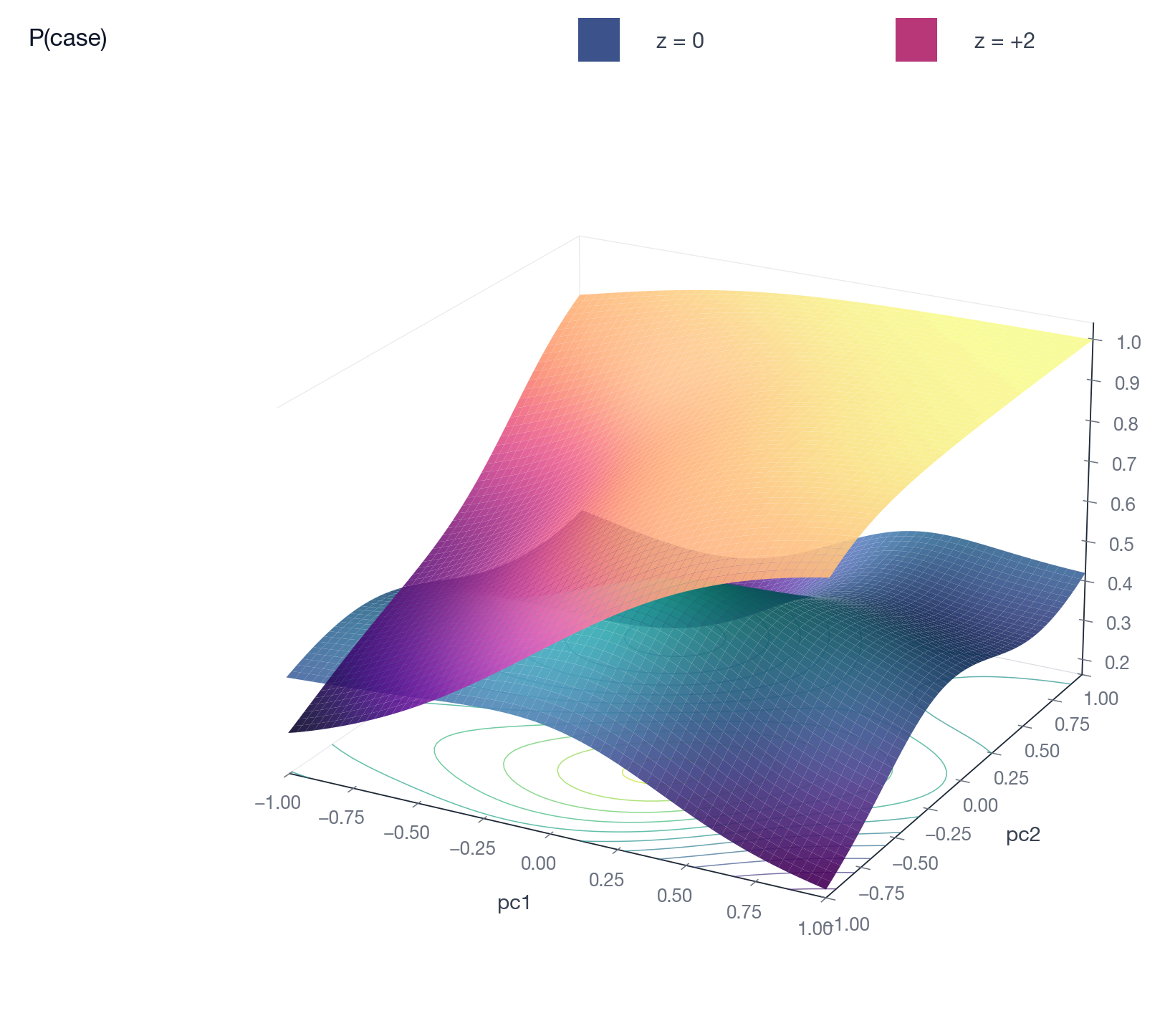
The vertical gap between the two probability surfaces is the risk
difference for a unit contrast in z. The modelled score effect lives on
the probit/log-slope scale and varies smoothly with covariates.
Two families:
- Bernoulli marginal-slope (
family="bernoulli-marginal-slope") for binary outcomes. - Survival marginal-slope (
survival_likelihood="marginal-slope") for time-to-event outcomes.
Both assume z is approximately N(0, 1) conditional on the covariates.
Use the transformation-normal calibration step to enforce that.
When to use it
You have:
- A binary or time-to-event outcome.
- A continuous risk score that is, or can be made, conditionally
N(0, 1). - Reason to believe the score's effect size varies across covariates (e.g. across age, ancestry PCs).
A single-coefficient logistic or Cox fit on outcome ~ score + ...
forces one slope on the score. Marginal-slope makes the slope itself a
smooth function of covariates while leaving the baseline as a separate
smooth.
Stage 1: transformation-normal calibration
If the raw score is not already conditionally N(0, 1), fit:
calib = gamfit.fit(
    df,
    "raw_score ~ duchon(pc1, pc2, pc3, pc4, centers=20)",
    transformation_normal=True,
    scale_dimensions=True,
)
df["z"] = calib.predict(df)
transformation_normal=True fits h(score | covariates) ~ N(0, 1). The
predict() method of a transformation-normal model returns a 1-D numpy
array of z-scores.
Stage 2a: Bernoulli marginal-slope
model = gamfit.fit(
    df,
    "case ~ s(age) + matern(pc1, pc2, pc3)",
    family="bernoulli-marginal-slope",
    link="probit",
    z_column="z",
    logslope_formula="matern(pc1, pc2, pc3)",
    scale_dimensions=True,
)

probs = model.predict(test_df, return_type="dict")["mean"]
family="bernoulli-marginal-slope"selects the marginal-slope likelihood.link="probit": required. The Bernoulli marginal-slope kernel is derived for the probit base link and rejects any other link choice, includingflexible(...),blended(...),sas, andbeta-logistic.z_column="z": name of the conditional z-score column in both the training and prediction tables.logslope_formula="...": formula for the log-slope surface as a function of covariates.
The main formula controls the baseline risk; logslope_formula controls
the strength of the z effect at each point in covariate space.
CLI equivalent:
gam fit data.csv 'case ~ s(age) + matern(pc1, pc2, pc3)' \
    --logslope-formula 'matern(pc1, pc2, pc3)' --z-column z \
    --scale-dimensions --out model.gam
For vector-valued scores, place the first coordinate in --z-column and
add one logslope(z_col, ...) declaration per additional coordinate
inside --logslope-formula:
gam fit data.csv 'case ~ s(age) + matern(pc1, pc2, pc3)' \
    --z-column z1 \
    --logslope-formula 'matern(pc1, pc2, pc3) + logslope(z2, s(age)) + logslope(z3, matern(pc1, pc2, pc3))' \
    --scale-dimensions --out model.gam
The unwrapped RHS is the log-slope surface for the first coordinate.
Each extra logslope(z_col, ...) adds a surface for that coordinate
with its own coefficients and smoothing parameters.
Stage 2b: Survival marginal-slope
model = gamfit.fit(
    df,
    "Surv(entry, exit, event) ~ s(bmi) + s(hba1c)",
    survival_likelihood="marginal-slope",
    z_column="z",
    logslope_formula="s(bmi) + s(hba1c)",
)

pred = model.predict(test_df)
S = pred.survival_at([1, 5, 10])
The main formula specifies the baseline hazard surface; the score's log
hazard ratio is a smooth function of covariates given by
logslope_formula.
Frailty in marginal-slope survival
Survival marginal-slope supports only frailty_kind="gaussian-shift"
with a fixed frailty_sd. "hazard-multiplier" and a learnable
gaussian-shift sigma are rejected at fit time.
gamfit.fit(df,
    "Surv(entry, exit, event) ~ s(age)",
    survival_likelihood="marginal-slope",
    z_column="z",
    logslope_formula="s(age)",
    frailty_kind="gaussian-shift",
    frailty_sd=0.3,
)
Detecting marginal-slope models after loading
model = gamfit.load("model.gam")
model.is_marginal_slope            # True if a marginal-slope family
model.is_survival                  # True if survival
model.is_transformation_normal     # True if a Stage 1 calibration model
model.model_class                  # full class string
Notes
- Run Stage 1 (transformation-normal) before Stage 2 so
z_columnis conditionallyN(0, 1). - Set
scale_dimensions=Truewhen calibrating on a handful of PCs so anisotropic length scales are learned per axis. - Posterior sampling: Bernoulli marginal-slope and transformation-normal
models use the Gaussian Laplace approximation in
Model.sample(...); survival marginal-slope uses NUTS over the joint coefficient vector. See posterior-sampling.md. - Predict output: Bernoulli marginal-slope returns a 1-D probability
array by default. Pass
id_column=orreturn_type="dict"for a table. The same applies to transformation-normal models.
Two-stage pipeline
import gamfit
import numpy as np
import pandas as pd

n = 1000
rng = np.random.default_rng(0)
df = pd.DataFrame({
    "PGS":  rng.normal(0, 1, n) + 0.3 * rng.normal(0, 1, n),
    "pc1":  rng.normal(0, 1, n),
    "pc2":  rng.normal(0, 1, n),
    "pc3":  rng.normal(0, 1, n),
})
df["disease"] = (rng.uniform(0, 1, n) < 0.25).astype(float)

# Stage 1: condition the score on PCs
calib = gamfit.fit(
    df, "PGS ~ matern(pc1, pc2, pc3, centers=20)",
    transformation_normal=True, scale_dimensions=True,
)
df["pgs_z"] = np.asarray(calib.predict(df), dtype=float)

# Stage 2: Bernoulli marginal-slope
model = gamfit.fit(
    df,
    "disease ~ matern(pc1, pc2, pc3, centers=20)",
    family="bernoulli-marginal-slope",
    link="probit",
    z_column="pgs_z",
    logslope_formula="matern(pc1, pc2, pc3, centers=20)",
    scale_dimensions=True,
)

test = df.head(50).copy()
probs = model.predict(test, return_type="dict")["mean"]